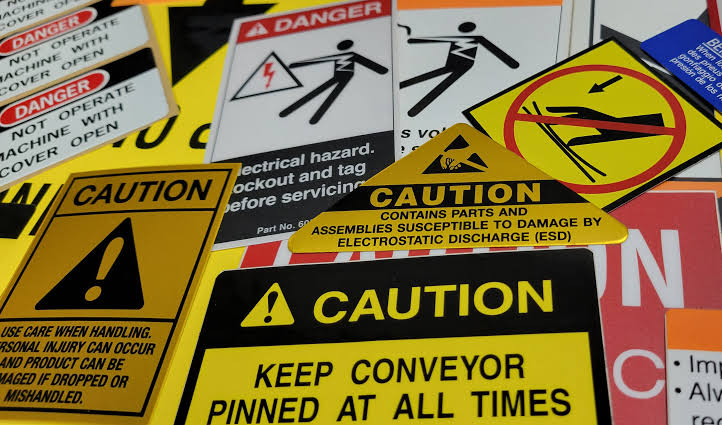

Industrial labels are an essential part of modern manufacturing and industrial operations. They are used to identify machinery, electrical components, products, assets, equipment, and containers while displaying important information such as serial numbers, specifications, safety instructions, barcodes, and QR codes. Unlike ordinary labels, industrial labels are designed to withstand demanding conditions such as heat, moisture, chemicals, abrasion, UV exposure, and frequent handling.
For industries across India, selecting the right industrial label is important for maintaining product identification, safety, traceability, and operational efficiency.
Industrial labels are specially designed labels used for identification and information purposes in industrial environments. They can be customized in different sizes, shapes, materials, adhesives, colours, and finishes according to the application.
Depending on the industry and operating environment, industrial labels may be required to withstand high temperatures, chemical exposure, outdoor weather conditions, oils, solvents, moisture, and mechanical abrasion. The label material, adhesive, printing technology, and protective coating all influence its durability and performance.
Industrial labels provide more than basic product identification. They help businesses organize equipment, improve workplace safety, maintain traceability, and manage inventory efficiently.
Some important benefits include:
Different industries require different types of industrial labels based on their application and environmental conditions.
1. Machinery Labels
Machinery labels are used on industrial equipment to display model numbers, technical specifications, operating instructions, warning information, and maintenance details. They can be manufactured using durable materials that withstand heat, oils, abrasion, and other industrial conditions.
2. Asset Labels
Asset labels help businesses identify and manage machinery, tools, electrical equipment, computers, and other valuable assets. Serial numbers, barcodes, and QR codes can be incorporated to support asset tracking.
3. Safety and Warning Labels
Safety labels communicate warnings, operating precautions, hazard information, and instructions. They are commonly used on industrial machinery, electrical panels, production equipment, and other workplace installations.
4. Barcode and QR Code Labels
Barcode and QR code labels support digital identification and traceability. They can be used for inventory management, product tracking, equipment records, logistics, and maintenance systems.
5. Electrical Labels
Electrical labels are used on control panels, switchgear, electrical equipment, cables, circuit boards, and other electrical components. Depending on the application, materials such as polyester, polycarbonate, and polyimide may be selected for durability and resistance to heat and chemicals.
6. Chemical-Resistant Labels
Chemical-resistant labels are designed for applications where labels may come into contact with oils, solvents, cleaning agents, fuels, or other chemicals. Appropriate material and adhesive selection helps prevent peeling, fading, or loss of readability.
The choice of material is one of the most important factors when selecting an industrial label.
Polyester Labels
Polyester is widely used for durable industrial identification because it can provide resistance to heat, chemicals, moisture, and abrasion. It is suitable for machinery, electrical equipment, outdoor applications, and product identification.
Polycarbonate Labels
Polycarbonate labels are suitable for demanding applications where scratch resistance, dimensional stability, and durability are important. They are commonly considered for control panels, electrical equipment, and industrial machinery.
Polyimide Labels
Polyimide is particularly useful for applications involving high temperatures, including circuit boards and electronic components.
Vinyl Labels
Vinyl labels provide flexibility and can be suitable for general industrial identification, outdoor applications, pipes, equipment, and curved surfaces.
Aluminium Labels
Aluminium labels and tags can be used where high durability and resistance to harsh industrial conditions are required.
Industrial labels are used across a wide range of sectors throughout India, including:
In automotive and engineering applications, labels may need to withstand chemicals, temperature fluctuations, vibration, and abrasion. In logistics and warehousing, barcode and identification labels support product tracking and inventory operations.
Choosing an industrial label should begin with understanding the conditions in which it will be used. Businesses should consider:
Surface:
Determine whether the label will be applied to metal, plastic, glass, painted surfaces, or another substrate.
Temperature:
High-temperature applications may require specialized materials and adhesives.
Chemical Exposure:
If the label comes into contact with oils, solvents, or chemicals, choose an appropriate chemical-resistant construction.
Outdoor Exposure:
Outdoor labels may require resistance to sunlight, moisture, and weather conditions.
Adhesive:
The adhesive should be compatible with the surface and provide the required level of permanence and temperature resistance.
Printing Requirements:
For barcodes, QR codes, serial numbers, and technical information, the printing method should provide clear and durable results.
Industrial applications often have different requirements, so standard labels may not always be suitable. Custom industrial labels can be produced according to specific dimensions, shapes, materials, adhesive requirements, printing specifications, and finishing requirements.
Businesses can also incorporate variable information such as serial numbers, batch numbers, barcodes, QR codes, product specifications, and safety instructions. This makes custom industrial labels useful for both identification and traceability.
Industrial labels are an important component of India's manufacturing and industrial sectors. From machinery and electrical panels to automotive components, warehouses, and production lines, durable labels help businesses maintain identification, safety, traceability, and operational efficiency.
Selecting the appropriate material, adhesive, printing method, and protective finish is essential for achieving reliable label performance. Businesses looking for Industrial Labels in India should choose customized solutions based on their specific application, environmental conditions, and durability requirements.
Fill out the form below to start a conversation with us on WhatsApp.
Fill out the form below to start a conversation with us on WhatsApp.